

CRITICAL ESSAYS
On the ethics of transformation
Renata Adler develops a body of work in which transformation does not appear as a theme, but as a condition. Her practice is built around the idea of passage, of everything that does not settle or conclude, but continuously reorganizes itself over time. More than producing objects, the artist investigates processes, states, and shifts, understanding artistic practice as a living field of transmutation of matter and of the subject itself.
The journey is always more important than the finished form. Materials marked by use, wear, and abandonment, such as broken glass, pruned wood, reused metals, and everyday residues, enter her work not as symbols or acts of denunciation, but as active matter. These elements carry memory, friction, and history, and are treated as bodies in transit. Rather than reinforcing easy narratives around sustainability, Renata proposes a quiet refusal of the logic of obsolescence, affirming continuity where disposal is expected.
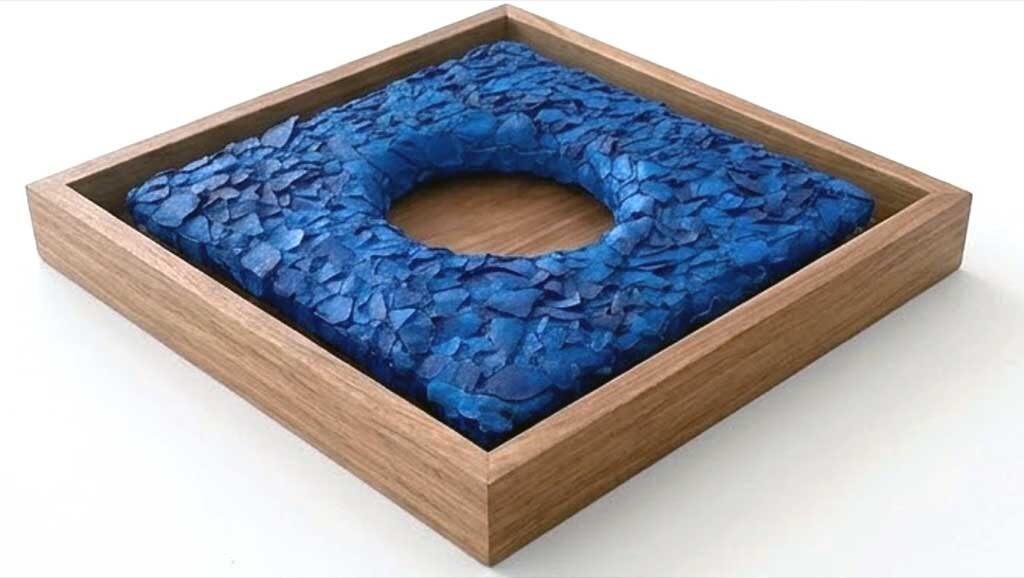
In the series Cacos da Vida, glass becomes the central element of this investigation. Associated with fragility and rupture, it is collected, broken, and reorganized, revealing a process in which the fragment ceases to signify loss and assumes a condition of potency. The works reveal a clear movement of recomposition, in which rupture is not erased but incorporated. The memory of impact remains visible, now reorganized within another structure of meaning. There is no attempt at idealized repair, but rather the affirmation that what breaks can continue to exist in another form.
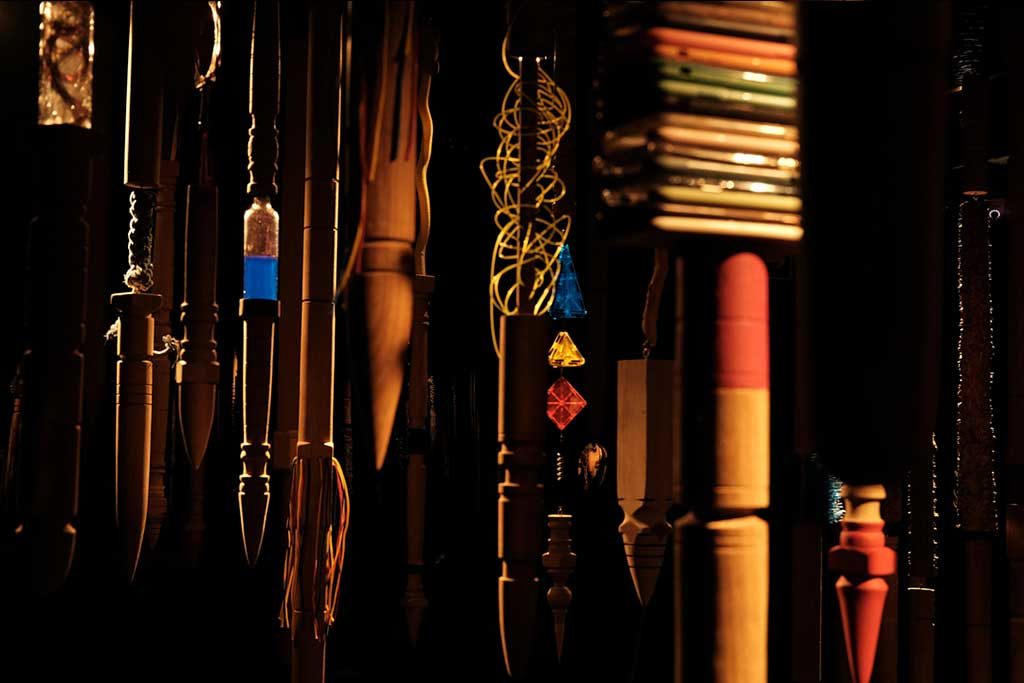
This logic expands in the series and installation Camaleões, where transformation takes on a more directly existential dimension. The chameleon emerges as a figure of adaptation and survival, not as passive camouflage, but as a form of sensitive intelligence in relation to its environment. The sculptures, often arranged as an immersive forest, create a space of passage where body, nature, and architecture are placed in tension. Vertical structures made of wood, steel, copper, acrylic, and recycled materials evoke trees, columns, and alert organisms, as if in a permanent state of listening.
This stance runs throughout her entire practice. In approaching Lavoisier’s maxim, according to which nothing is created or lost, only transformed, the artist is not making a scientific citation but affirming an ethic. Her work does not offer answers or propose solutions. It creates states of attention. It invites the viewer to recognize, in the materials and within themselves, continuous processes of change, adaptation, and persistence.
Renata Adler operates in a territory where art, experience, and thought meet without hierarchy. Her work does not
seek immediate impact or spectacle, but the construction of spaces of duration, where time expands and transformation ceases to be a promise and becomes a daily practice.
Mariana Bahia,
Curator
EXHIBITION
O Mergulho, de Renata Adler
Farol Santander São Paulo
Exhibition: December 8th, 2023 to March 3rd, 2024
O Mergulho, the title of Renata Adler’s individual exhibition, is not an invitation to dive into the water, but an opportunity to rethink consciousness. “What if the latter was not only a continent, which seems to grow as we explore it, but also the very image of infinity?”, the artist seems to be telling us. Understanding the universe on a large scale, understanding the essence of life, and understanding our own situation of being thrown into the world seems to be what she is inviting us for. So much so, is she suggesting by her large immersive sculptural installation at the Farol Santander a synthesis between knowing the world and knowing oneself in order to transform oneself for the better?
“In nature nothing is created, nothing is lost, everything is transformed”, Lavoisier
Perpetual transformation is a leitmotif for Renata Adler, who endorses the famous quote from Antoine Lavoisier (1743-1794), the great French chemist considered the father of modern chemistry: “In nature nothing is created, nothing is lost, everything is transformed.” With it, the law of conservation of energy states that energy can neither be created nor destroyed. It can only be transformed from one form to another or transferred from one place to another. This is the central message of this immersive installation.
Renata completes her thoughts by quoting the great Greek philosopher Socrates (- 470/469 – 399): “The secret of change is to focus all your energy not on fighting the old, but on building the new”. It leads you into deep positive reflections, a philosophy as a way of living. Does not every authentic philosophical approach include, as a constitutive moment, this joyful questioning, critical without acrimony, applied to our beliefs, our behavior and our lifestyles? Renata thinks of this perpetual transformation, that is the essence of life itself in the sense of improvement. It is a beautiful message she sends to visitors to the Farol Santander exhibition.
A forest of chameleons
“…with the sun entering the forest of my chameleons…echoing transmutation of being and matter, renewing and being reborn every moment…” RA
By just entering the exhibition, the visitor is, therefore, engulfed in a forest of mobiles that the artist calls “chameleons”, an immersive installation that, through a subtle play of reflecting materials, playing a mirror effect, makes you lose your sense of proportion and multiplies the work. These are sculptures in turned wood, sometimes partly painted, to which the artist adds numerous heterogeneous elements. For her, the chameleon is not that one who hides by adopting camouflage but on the contrary, the one who knows how to adapt to each circumstance and evolve to better blend into life.
A Prévert-style inventory?
Jacques Prévert (1900-1977) published Paroles in 1946. He wanted to free himself from all traditional rules to create poetry close to spoken language and marked by a taste for anaphora and enumeration. With his inventory, he offers a sort of list poem characteristic of the surrealist movement, in search of the surreal, which is to say a superior reality where the importance of freedom, dreams and unstructured language are essential. It is a succession of images with no obvious relationship to each other. Prévert plays with the freedom of expression that his inventory offers him. He can place surprising and absurd images side by side and call them up at random. With Mergulho, Renata Adler does not just deliver a light and haphazard list. Her “inventory” of chameleons seems to observe, from above, the evolution of the contemporary world.
The materials she uses are gateways to rethinking this world in perpetual transformation with its possible futures and its concerns. Many types of wood appear in her work: olive wood (one of the world’s oldest symbols, unchangeable over time and of timeless value. The symbolism of the olive tree is peace, fertility, wisdom, immortality, prosperity, and success), cajá mirim, avocado tree, Jaboticaba tree (rich in antioxidants), Phoenix (symbol of the resurrection which awaits the deceased after the weighing of the souls), Urucum seed (a red fruit native to Tropical America, used for body paint, cooking and medicine. In the Mebêngôkre language, of the Kayapó indigenous people, urucum designates a sacred plant, called Pykoré, which bears the symbol of abundance); palm seed (symbol of resurrection, associated with paradise, with Christ, with the phoenix bird, imbued with wonder).
Her chameleons, all different from each other, are also made up of recycled masks and pigments, cat’s eye (traffic signs), electrical conduit, expired medicines, microplastics, plastics, toothbrushes, cotton swabs, hoses, toys, catalogue/book, glass bottles, nautical cables, scrap copper from air conditioning and lighting, mirror trim, steel and acrylic… everything we find today in this Plastic Island, the Seventh Continent, that the consumer society leaves to future generations.
She did not want to title all her chameleons but, when she does, it is to leave us messages, like bottles in the sea entrusted to the random waves of our thoughts: Microplastic (in honor to the documentary Plastic Ocean), Pandemic, Sun, Moon, Prescription drugs (pills, medication), Cure, Renewal of Life, Reflection of the Soul, Liquid State…
A walk in this forest of 272 chameleons ends when you arrive in front of an aquarium installation that has projections on it, which are like breaths of life on these isolated pieces of sea.
The transformations in the exhibition O Mergulho that Renata Adler proposes are therefore part of her artistic and philosophical questions: movement, change, integration and synchronization, with all the risks and uncertainties that this type of work produces. The movement has an essential place in the Aristotelian ontology that inspires it, as it is through movement that the philosopher will be led to recognize “the diversity of meanings of being”. For the first Greeks, movement was flux par excellence, the indefinite, the unlimited… an unfathomable chaos where the best can always happen.
Marc Pottier
Curador

EXHIBITION

A Continuous Transformation
Casa de Cultura Laura Alvim, Rio de Janeiro
Exhibition: February 8th to March 31st, 2019
As we enter Casa Laura Alvim, we are faced with Renata Adler’s latest ‘Camaleões’ (‘chameleons’), in the new individual exhibition by this emerging artist and sculptress from Rio de Janeiro. But this is not really about an acrobat animal that can point an eye to the ground and another to the sky, whose tongue springs forward to capture insects and that has a proverbial capacity to change colour. Her exhibition goes further and is called “A Continuous Transformation”.
Her ‘camaleões’ are fine columns made of turned wood housing different round and plane shapes, and partly painted. Some metallic elements or small mirrors appear occasionally, challenging the verticality of the piece. They spring from the ground, fall like rain from the ceiling or seem to pierce the walls, evoking the rhythm of the lances found in “The Battle of San Romano”, painted by Paolo Uccello around 1456. With their parallel, perpendicular and oblique lines, Renata’s ‘camaleões’ compose a set of straight lines whose vanishing point disappears from view, plunging the spectator into this exhibition-installation. The resulting ensemble vibrates in a generally white atmosphere, going from the windows that connect us to the energy of Ipanema beach to the dark rooms that invite the viewer to focus on the sculptures and on a video projected on a bronze tissue wall.
The transformations proposed by Renata Adler are part of her artistic and philosophical questionings: motion, change, integration and synchronization, with all the risks and uncertainties generated by this type of work. Motion plays an essential role in the Aristotelian ontology that inspires the artist, as it drove the philosopher to recognize “the several senses of being.” For the early Greeks, motion corresponded to flux, to the indefinite, the unlimited… to unfathomable chaos.
Looking at her work, we cannot help thinking of lingams. As we dive into symbols, and more specifically those related to Indian culture, the lingam, always erect and therefore a potential creator, is often associated with the yoni (‘place’), a symbol of the goddess Shakti and of female energy. In this case, their union represents, as Shiva, the wholeness of the world. Assuming the creative function through the lingam and the traditional destructive function, Shiva represents, therefore, the ultimate god. Renata clarifies: “It is all a matter of transformation to me. In my chameleons, I dare evoke freely the “Anima e Animus” that Carl Gustav Jung refers to in his “The I and the Unconscious”. As an artist, as a woman, I speak about my masculine side, and about my pleasure in facing a physical sculptor’s work, even if the _nal result of my work, with its turned, plump woods underlined by colourful painted rings, is frankly feminine.”
Renata Adler takes us far in her transformation games, and the myth of Prometheus could also be an allegory for this work. Indeed, it features the two inseparable dimensions of the human condition: that of the conquest and adventure of Man drawing his own path, but also that of the ancestral fear of transgression, of trying to rival with the gods. In reality, we already observe that this permanent tension between freedom without limits to the glory of Man and an attachment to nature within its own borders is present in Humanistic culture, hence the difficulty in recognizing those limits… But fear today derives, on the one side, from an amazing scientific and technological power, and on the other side from what is now called a “crisis of the future”, that is, our difficulty in thinking an ever more uncertain world, where the ideology of continued progress is far from obvious. The works of Renata Adler presented in Rio de Janeiro’s Casa Laura Alvim wish to invite the public to reflect on a world under perpetual transformation.
Marc Pottier
Curator
EXHIBITION

The Path of the Planets
Two exhibitions in Rio de Janeiro
Hotel Santa Teresa Gallery M
August 17 to October 16, 2017
Parque das Ruínas
September 2 to 25, 2017
It is not just by chance that Renata Adler tries to appropriate in her work the formula of the renowned eighteenth-century French philosopher Lavoisier, who is also often said to be the father of modern chemistry: “Nothing is lost, everything is transformed.”
This is because one of Lavoisier’s most important research projects involved determining the nature of combustion or of rapid oxidation. What matters to Renata is precisely the energy in the reaction of matter. In Renata’s sculptures made of iron or other materials, there is a provocation of the state of matter that contributes to chemical revolutions, sometimes technical, experimental or epistemological. Without hesitation she typically uses unusual elements, such as coffee, adding another sensorial dimension. If in the artwork Mundos Entrelaçados (Interlaced Worlds) she chose not to interact with the materials used, allowing them to change without any interference, in Planetas (Planets) she painted delicate and colorful landscapes that will evolve over time. There is a desire to speak of “impressions” even if her works are not impressionistic in the sense of the word. This is because, in addition to the dialogue between matter and painting, she also loves light, manifested in Planetas in which she discreetly placed LED lights behind the worked plates. It draws heavily on a critique of Claude Monet’s work that read: “Claude painted what he saw. If he saw wind, he would put wind in his pictures.” She tries to introduce the cosmos.
It was precisely this work on the energy of matter that caught my attention when, in one of my habitual visits to artists’ studios, I discovered the works of this artist, who is now emerging with her first exhibition.
Renata has flirted with the art world from an early age. She has always loved painting and photography, and even developed her own photos, but she ended up becoming attracted to sculpture. The solar system has always fascinated her. This is why the exhibition “The Path of the Planets” speaks of a life experience that transcends the present. I find it interesting how she emphasizes this: “my head seems to be in the stars, on the other hand, my feet are firmly stuck to the ground”.
The word cosmos comes from the Latin cosmos (world), which in turn comes from the ancient Greek kósmos (order, ordered), and by extension, the order of the Universe. The planets, galaxies, and stars of Renata’s works not only speak of everything that exists but also try to propose a philosophy that evokes a Universe as a well-organized system. At a time when new generations are hunched over with their eyes glued to screens, she would like to invite them to lift their heads and look up at the sky that many of us neglect. She wants to offer a voyage that links the Earth’s energies.
Getting inspiration from the way nature crafted the margins of a creek that ran near her childhood home, she tries to express through the living matter she uses in her works the little microcosms of Mankind in opposition to the macrocosms of the Universe.
“For me, everything is a matter of energy and I constantly refer to ‘chakras’,” says Renata. “If today this word is better known to mean points where energy channels converge, this term, in fact, comes from Sanskrit and refers to disc-shaped objects, including the sun. In the past, in India, these were metal discs, including gold, copper, or iron, materials I like to use. The main chakras are associated with color, and when I observe myself, green, a symbol of a beating heart, air, and mystery, is the first to appear. So rather unconsciously, I expose this umbilical cord in my work linking the life of Man to the mysteries of the Cosmos.”
Colors are very important to her. As Kandinsky said: “Colors are the keys, the eyes are the hammers and the soul is the piano with its strings.” Forms and colors are not the results of simple associations of arbitrary ideas, but of an interior experience that, in Renata’s abstract paintings, refers to the senses. She usually works on previously drawn forms to which she adds colors, observing its subjective effect. She allows shapes and colors to interact in their own alchemy. Her intention is not to say that these are scientific or objective observations, but rather that they are totally subjective and purely phenomenological.
As Renata says, “Everything is a matter of transformation.” In Camaleões (Chameleons), she dares to evoke spontaneously “Anima and Animus” referred to by Carl Gustav Jung in his work “The Relations Between the Ego and the Unconscious.” As an artist and as a woman, she speaks of her masculine side and of her pleasure when she has to come face to face with the physical demands of a sculptor’s work, even if her work, well rounded lathed woodwork highlighted by rings of painted color, is frankly feminine.
Underlying Renata’s works, however, are the transformations she likes to talk about, the connections between the Earth of Mankind and the Infinity of the Universe, wherein lie all the fundamental questions that we ask ourselves. In a vast process of apparent disenchantment with a world where humanity is no longer at the center, nor the end, and not even a privileged species at the top of the evolutionary tree, what relations can we expect between Nature and Humanity? Are we facing an absurd Universe, as Sartre’s existentialism proclaims, or is it perhaps necessary to wait for the end of a crisis of cosmic mutation that will give rise to a new and positive relationship between the Universe and Humanity? And what if the end of our human illusions, so excessive, helps to reunite us with reality and establish an enriching relationship with nature and the immensity of the Cosmos?
Marc Pottier